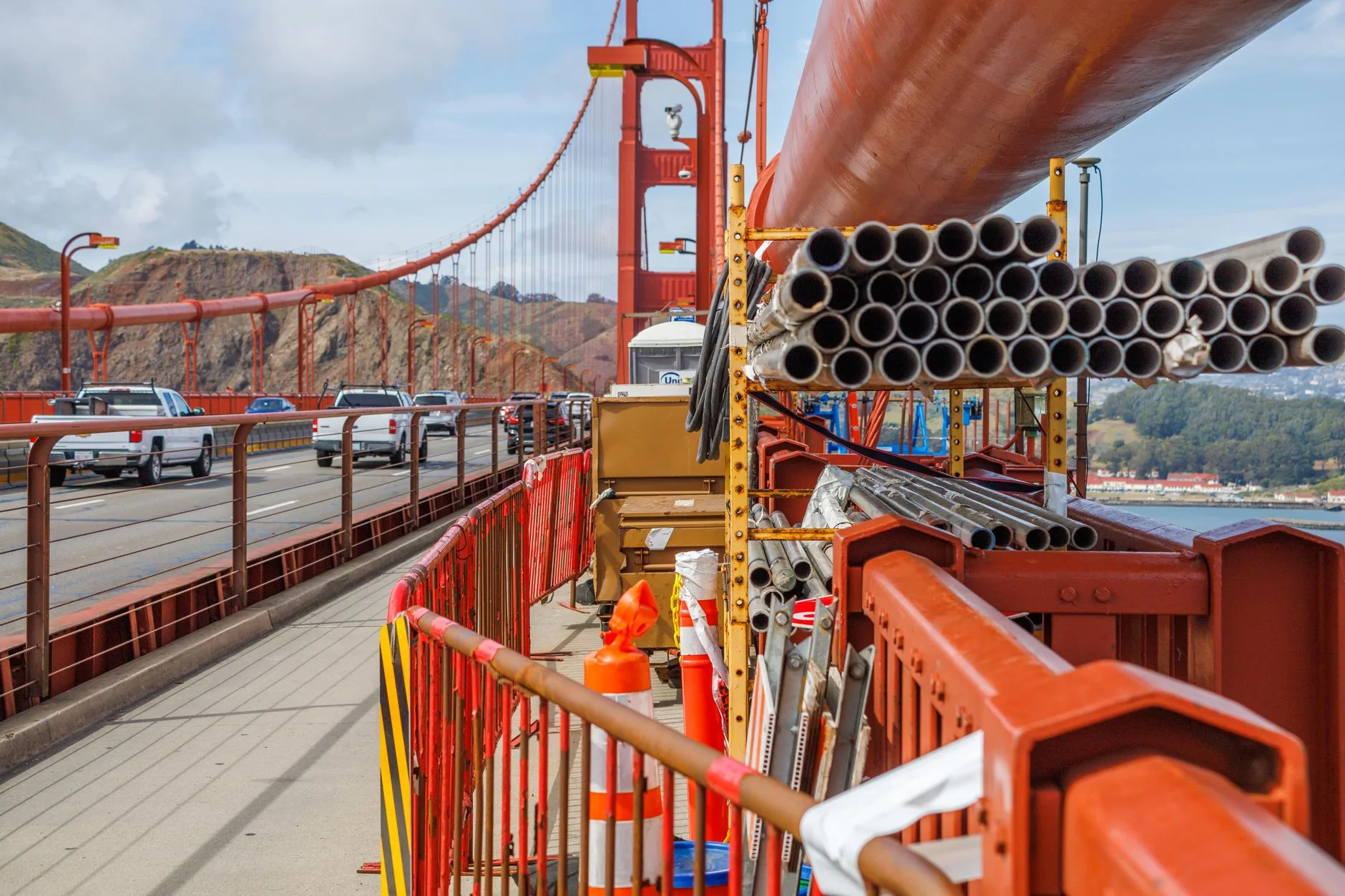
The Golden Gate Bridge, Highway and Transportation District board authorised about $1.01 billion in allocations for the final seismic phase on 24 October 2025. The project total now exceeds $1.8 billion. The original estimate was about $880 million. The district and the construction trade press attribute the increase to post-pandemic price rises in construction and materials.
Phase 3B covers the main suspension span, both towers and the south tower pier. The district lists the phase as 2026 to 2036.
What the Board Approved
Three lines sit inside the vote. An $864 million contract with Halmar International LLC, a New York company. A $41.3 million contingency for unforeseen expense. A $141.7 million budget increase drawn from district reserves.
The three lines sum to $1.047 billion against the $1.01 billion headline. The record does not name the $37 million difference. Carry the named lines in a capital model and treat the headline as a rounding.
Two Contracts, Six Years Then Five
Contract 1 is the $864 million award. The district let it in October 2025 and puts construction at early 2026 for approximately six years.
Contract 2 follows completion of the first. The estimate is $900 million and the duration a further five years. No funding is attached. District official Paolo Cosulich-Schwartz said the district will develop a financing plan for that contract over the coming years.
Divided by their published durations, contract 1 draws about $144 million a year and contract 2 about $180 million a year. Ask the district to explain the step.
Where Contract 1's Money Comes From
A $395.7 million federal Bridge Investment Program grant, $200 million from the Caltrans Federal Highway Bridge Program and $274.3 million in district reserves. The three lines total $870 million against a contract and contingency of $905.3 million.
The $35.3 million balance carries no published source. District staff said the agency receives no dedicated state or local tax funding and draws about 80 percent of its capital spending from federal sources. Tolls are its primary revenue line.
A Grant That Carried Policy Risk
The US Department of Transportation wrote to the district in April 2025 warning that programmes premised on diversity, equity and inclusion classifications presume a violation of federal law. District staff said the $395.7 million grant was potentially at stake.
The board voted 11-3 on 27 June 2025 to rescind its earlier diversity resolutions and adopt a general human-rights resolution. KQED reported the vote and the general manager's account of the funding risk.
The grant covers about 44 percent of the contract 1 commitment. A delivery risk of that size belongs in the schedule assessment for the phase.
What the Schedule Means for a Revenue Plan
The construction calendar runs with the work. Weeknight lane closures run 8:00 p.m. to 5:00 a.m., Monday to Friday, with Friday work ending 7:00 a.m. Saturday. One southbound lane and two northbound lanes stay open.
A revenue plan written through 2032 sits inside contract 1. A plan written through 2036 sits inside the phase. Set the planning horizon from the durations the district published.
What a Vendor Signs Up To
The published terms are a value, a contingency and a duration. Payment terms, retainage, schedule of values and any escalation index are absent from the record.
Three questions follow for a firm bidding the work. Does the contract carry a price adjustment mechanism for materials and construction inflation? How do change orders draw on the $41.3 million contingency, and who authorises them? Does the award carry any commitment on contract 2?
Night work carries premium labour and lower output over six years. District engineer John Eberle said the project will create hundreds of union jobs.
The Schedule the Record Supports
The district lists Phase 3B as 2026 to 2036. The construction-trade report gives ten years for the phase, six for contract 1 and five for the second. The board coverage says more than ten years.
Carry the district window as the programme and each contract duration as its own figure. A lender underwriting past 2032 should hold the later date.
Questions to Put to the District
How the $1.01 billion reconciles to the named allocations. Whether the $141.7 million reserve increase sits inside the $274.3 million reserve contribution. When contract 2 will be financed and awarded. What escalation and change-order terms sit behind the $41.3 million contingency.
Until those answers arrive, Phase 3B is a ten-year programme with six years of funding.